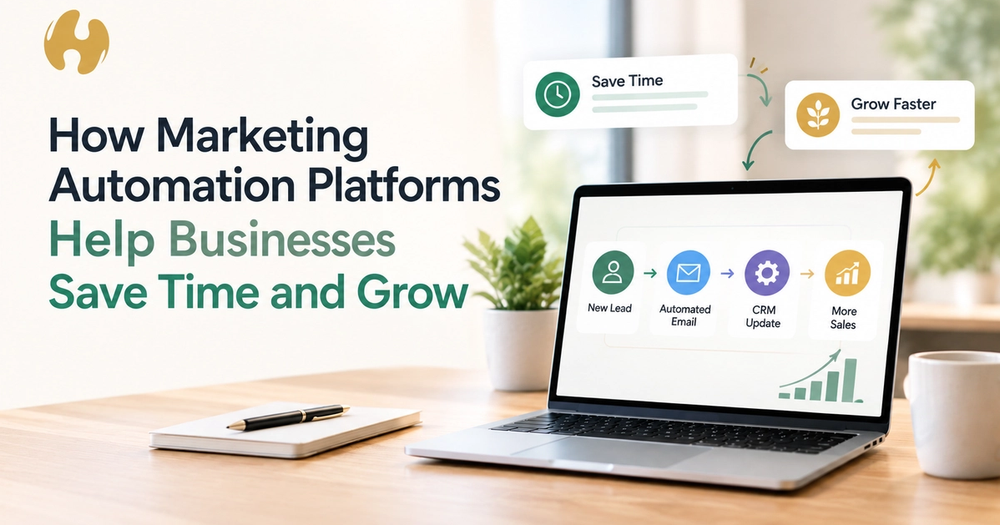
A lead fills in a form, and an automated email goes out. Then someone checks the CRM, decides whether the lead matters, tells sales, and sets a reminder to follow up on Thursday.
Plenty of businesses own marketing automation platforms and still rely on a person remembering what happens between systems. The email was automated. The checking, deciding, and chasing were not.
That gap is where most of the lost time sits, along with a good share of the growth that never arrived.
Key Points
- Automation saves time on routine work such as record updates, follow-ups, lead assignment, and reporting.
- It supports growth through faster, more consistent lead response.
- AI helps most when enquiries vary.
- The biggest gains come from connecting marketing with sales.
What Marketing Automation Actually Does
Scheduling an email is the smallest thing these tools do. The larger job is running a customer journey.
A form submission creates a record, behavior selects the segment, and a score decides whether sales hear about it. Nurture follows, and reporting shows what worked. Value builds when those steps join up, which is what marketing automation platforms are really for.
How Marketing Automation Platforms Save Businesses Time
Pressing send takes seconds. The savings sit in the tasks around the campaign.
Repetitive data entry
An inquiry gets retyped into the CRM, copied to a spreadsheet, and pasted into the campaign tool. Each copy invites a typo.
Manual follow-up
Someone has to remember who was promised a reply and when. That memory usually lives in inboxes and sticky notes.
Lead routing and handoffs
Without rules, a person reads each inquiry and decides who gets it. Routing sends it to the right colleague with the history attached.
Reporting and monitoring
Weekly summaries and dashboard checks are routine. Alerts flag only what needs attention.
How Marketing Automation Helps Businesses Grow
Saved time only matters if it changes what happens to inquiries. Automation does not create demand. It improves how a business handles the demand it already has.
Faster response means fewer leads go cold. Consistent follow-up keeps interested-but-not-ready buyers in sight. Better qualification tells you which leads are worth calling, so less demand leaks away and sales time is spent on people who are likely to buy.
It is better execution, not a growth switch.
From Fixed Rules to AI-Powered Automation
Fixed rules send a set email when someone downloads a guide. Behavior-based journeys combine several signals. AI-assisted automation analyses data and drafts variations.
Agentic workflows add an objective. The system chooses the next step and adapts, with human overrides available.
More autonomy is not automatically better. Rules suit predictable work. AI earns its place when input varies and needs interpreting.
What Should You Look for in an AI Automation Platform?
The useful question is whether a tool can work with the information and systems the business already depends on. The best AI automation platforms tend to share these traits:
- Connected data and CRM integration
- Workflow depth beyond the campaign
- Personalization based on behavior
- Human approval before sensitive actions
- Auditability, a clear record of what ran and why
- Links to sales and operations
- Practical implementation and support
What Does an Automated Lead Workflow Look Like?
- An inquiry arrives through the website form.
- A CRM record is created automatically.
- The system reads the message, interprets what was asked, and scores urgency.
- The lead is routed to the right salesperson.
- A follow-up is drafted, and a person approves it where the message is sensitive.
- The CRM updates and the lead enters the right customer journey.
The Hidden Cost of Marketing Automation Silos
Marketing automation platforms may nurture a lead perfectly well. Then someone still updates another system, creates a task, tells sales, and chases the customer.
Automating one department does not automate the workflow around it. Nobody should have to act as the integration layer between disconnected systems.
What Is the Difference Between Marketing Automation and Business Automation?
Marketing automation handles one part of the customer journey. That journey continues into sales, quoting, invoicing, fulfillment and retention, and automation is worth more when information keeps moving between them.
The Artificial Organisation takes that wider workflow view. It connects existing systems, reduces manual handoffs, and keeps people involved where judgment matters, rather than adding another software login.
What Should a Business Automate First?
Start with work that is frequent, repetitive, predictable, time-bound and measurable. Lead response, routing, reminders, and reporting usually fit.
The best first automation is rarely the most impressive. It is the dull task someone does every day without questioning it.
Avoid unclear processes, subjective decisions, and sensitive messages.
What Marketing Automation Cannot Fix
It can remove friction from a good process. It cannot fix weak positioning, a poor offer, unreliable data, an unclear process, or slow human follow-up.
Even the best AI automation platforms work with what they are given. If the CRM is full of duplicates, or nobody has agreed on what makes a lead sales-ready, automation will simply repeat the confusion faster.
Want to find out where automation could save your business time? Talk to The Artificial Organisation to map your workflow and identify practical opportunities for automation.
Frequently Asked Questions
What is a marketing automation platform?
Software that captures leads, stores customer data, and acts on behavior, linking messaging, scoring, CRM updates, and sales alerts.
How does marketing automation save businesses time?
It removes hidden work such as retyping data, sending reminders, routing inquiries and building reports.
Can marketing automation help a business grow?
Indirectly. It makes follow-up faster and more consistent, so fewer leads slip away. It cannot create demand.
How is marketing automation different from AI automation?
Rules drive predictable actions, such as a booking reminder. AI receives soft input, such as how urgent a question is.
What should I look for when choosing a marketing automation platform?
CRM integration, workflow depth, human approval, a clear audit trail and links to sales and operations.
Start With the Workflow, Not the Platform
The goal is not to automate every marketing task. It is to remove unnecessary manual work and connect the workflow while keeping people in control of important decisions.
If you want help seeing where the effort sits, talk to The Artificial Organisation about mapping your workflow.