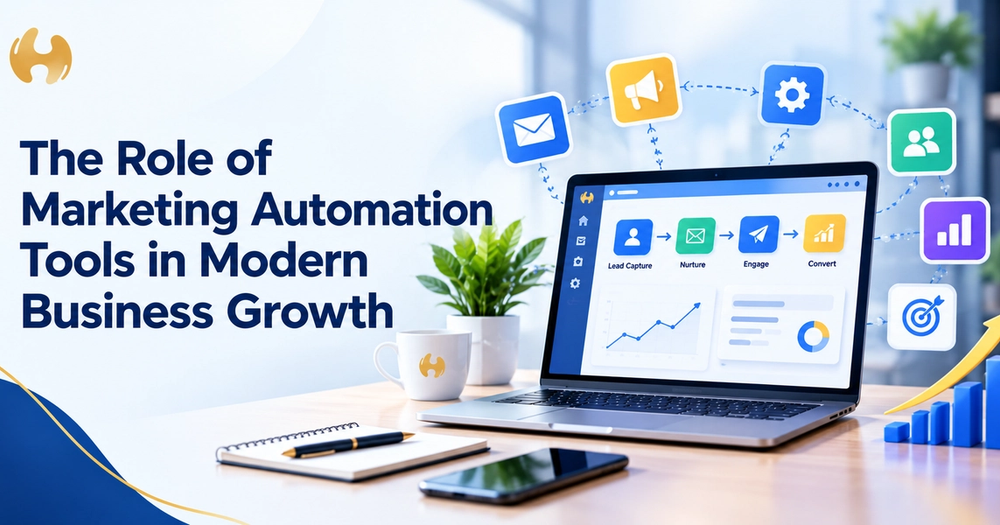
Marketing automation tools create growth when they turn a customer signal into the right next action. More emails and triggers create activity, but not movement towards a sale or repeat order.
Consider a prospect who requests a quote. The form is captured perfectly, but sales never sees the context, follow-up depends on someone remembering, and newsletters keep arriving long after the enquiry. Nothing has technically failed, yet the customer keeps waiting.
The workflow ran as configured. The journey still broke, and that gap decides whether automation helps a business grow. Seeing it clearly separates busy software from a useful system.
What Do Marketing Automation Tools Actually Do For Growth?
They watch for signals: a click, a pricing page visit, a reply, a booked call, a purchase, or silence. A signal alone is just data. Growth comes from what follows.
Context gives it meaning. A pricing page visit says little by itself, but alongside an open quote and a recent support query it points to a specific conversation.
Action makes that operational: a task for sales, a held message, a booking offer. The outcome shows whether it worked, and learning improves what happens next.
A tool that only sends the next email covers one link of that chain.
Where Does Growth Leak Between Marketing And the Business?
At the handoffs. A prospect replies and becomes a qualified enquiry, yet sales receives a name with no history.
Each platform may be doing its job. Marketing platforms typically know campaigns, contacts, and engagement. Quotes, bookings, invoices, and service history sit elsewhere.
A workflow can run exactly as built while the journey stays fragmented. The weakness lies in the process, the data, and the handoffs surrounding it.
The customer experiences one business. Many marketing automation solutions are strongest inside marketing workflows, while the action that matters often happens in sales, operations, service, bookings, or finance.
Why Does Customer Status Matter More Than Campaign Membership?
One person can be a subscriber, a prospect, an open quote, a current customer, and a likely repeat buyer at once. Campaign membership rarely reflects that.
The better question is what is true about them right now and what should happen because of it. The customer state is the live picture across marketing, sales, and service.
That requires exit conditions. A prospect who books a call should leave the nurture sequence. A new customer should stop receiving prospect messaging.
A customer with an unpaid invoice probably should not receive a renewal offer today.
Entry rules start automation. Exit rules keep it sensible.
When Does More Automation Make Marketing Worse?
When workflows overlap. Duplicate messages, conflicting offers, excessive contact and stale segments all grow with every workflow added.
More automation does not necessarily mean better automation. The goal is to trigger the right action at the right point in the customer journey, then stop when the customer's state changes.
Every workflow also needs an owner. Someone should know why it exists, who handles exceptions, what happens when an integration breaks, and when it should end.
Retire workflows that no longer reflect the current business. Without that discipline, automation debt builds: overlapping or outdated workflows that technically run but become increasingly difficult to explain, maintain, or govern.
What Does AI Marketing Automation Change?
Its most interesting contribution is interpretation, not copywriting. AI marketing automation can interpret a reply such as "I'd like to go ahead, but can we move the installation to Thursday and use the same package as last time?"
A rule-based workflow struggles because nothing arrives as neat fields. AI can identify the customer, read the requested change, retrieve the previous package, and prepare the next action.
It still needs defined workflows, rules, permissions, and human approval where the action matters.
Treat it as a better reader of messy input, not an autonomous decision-maker.
How Should Businesses Evaluate Marketing Automation Solutions?
Skip the feature checklist. Put practical questions to any marketing automation tools on your shortlist:
- What customer signals can it actually see?
- What context does it keep?
- Can workflows stop when a lead becomes a customer?
- What happens when information is incomplete?
- Can people approve important actions, and can you see why one fired?
- Who owns each workflow, and what happens when it breaks?
The best answer simplifies the operation. A tool that adds another layer to manage has not necessarily solved the underlying problem. Test it on a real, messy customer journey, not a polished vendor demo.
Connect The Signal To The Work
Businesses should not simply add more automation. Customer signals need to reach the right action across the systems already in use: enquiry, sales context, quote, approval, booking and follow-up.
Beyond marketing, the question is what happens across the business. That is the work. The Artificial Organisation focuses on connecting the systems a business already uses, so the work between them can flow. If your marketing data stops at the campaign, it is a sensible next step.
Start with one journey, such as quote requests, and see where it stops.
FAQs
What does marketing automation actually automate?
Repetitive sending, routing, tagging, and follow-up. The valuable part is acting on signals, such as a reply or pricing page visit, with the right context.
How does AI marketing automation differ from traditional automation?Traditional automation does what it is told with data that arrives in tidy fields. AI can read a messy email and work out what the customer wants. Rules and a person still decide what happens next.
What should I look for in marketing automation solutions?
Check which signals it can actually see, whether it keeps customer history, and whether it can stop a sequence when someone buys. You also want sign-off on important actions and a named owner for every workflow. A long feature list matters far less.
When does automation become counterproductive?
When workflows start overlapping and no one knows who owns them, it can become counterproductive. Customers usually notice first. They keep getting messages that made sense last month but make none now.
Can marketing automation work with existing business software?
Usually, yes. Most tools connect to a CRM, and some also connect to quoting, booking, or accounting software. How far that goes varies, so ask what the tool can read from those systems and what it can trigger.