If you run a business, you have probably tried an AI tool by now. You signed up, typed a question, got a clever answer, and went back to work. Nothing about the business changed. The quote still had to be written. The invoice still had to be chased. The question from the new starter still came to you.
That gap, between a clever answer and work actually getting done, is the whole story of AI for small business in Australia right now. This post is about the difference between an AI tool and a done-for-you AI platform, and why it matters more than which model is smartest this month.
The three kinds of AI you will be offered
Strip away the marketing and there are three things on the table. They look similar in a demo. They are nothing alike a month later.
AI tools
A chatbox in a browser tab. It is impressive, and it starts from nothing every single time. You explain the business before it can help, it writes some text, and then you copy that text somewhere else and do the actual job yourself. The knowledge never sticks, and neither does the habit.
AI features inside your software
Your accounting software adds an assistant. Your inbox adds a summariser. Each one knows its own system and nothing else. The assistant in your accounting software has no idea what you promised the client in March, because that promise lives in an email thread and a phone call.
A done-for-you AI platform
One place your whole team works from, connected to the software you already use, with an assistant inside that knows how your business runs. It is built for you by a team, not assembled by you on a weekend. That is what TAO is, and it is the only one of the three that changes how the work gets done.
What done-for-you means in practice
The phrase gets used loosely, so here is what it means at TAO. Our team does the work of making it fit your business. Your team just uses it.
- Discovery. We sit with you and learn how the business actually runs: how a quote gets built, why that client gets a different price, what happens when a deposit is late.
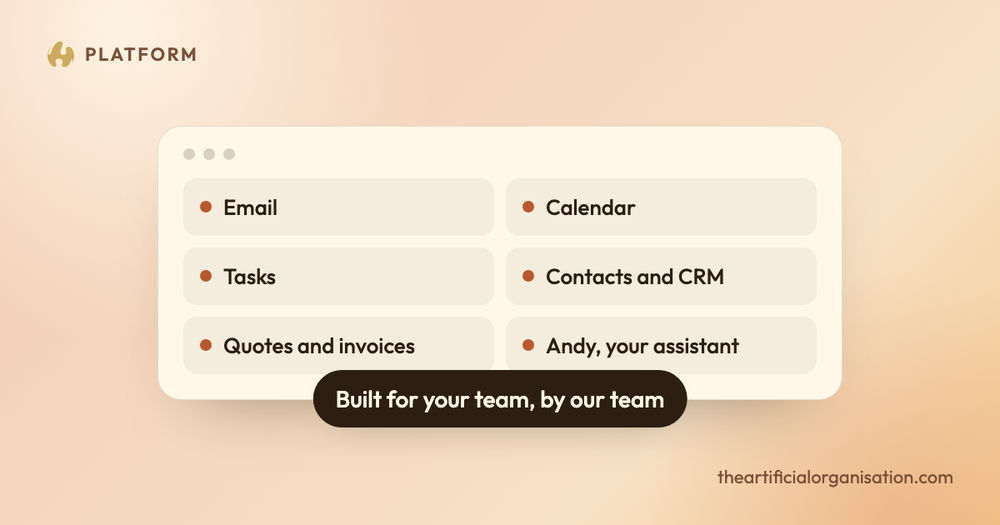
- Build. We shape the modules around that. Email, calendar, tasks, contacts and more, plus anything custom your trade needs, like a run sheet or a job costing view.
- Connect and run. We connect the systems you already use, load the company brain, and switch it on. From then on, Andy works inside it every day.
There is no course to take and no prompt library to learn. If something needs to change, you tell us, and we change it. You can read the whole process at How it works.
The difference is where the knowledge lives
An AI tool has to be told everything, every time. A done-for-you AI platform starts with a company brain: what TAO learns about how your business works from the documents, email threads, calendar, accounting, job notes and decisions you already produce.
That is why the answers sound like you. Ask Andy what the deposit terms are for a weekend hire and it answers the way you would, because it learned the answer from the last hundred times you gave it. And it keeps learning from every day since, so a correction you make once is a correction that sticks.
Every answer shows its source. If Andy says the balance is due seven days before the event, you can see the document or thread it came from. That matters more than people expect once the whole team starts relying on it.
An assistant, not a chatbox
The second difference is that a platform has an assistant. At TAO the assistant is called Andy. Andy does the doing: drafts the reply, builds the quote from the enquiry, creates the invoice in your accounting software, books the site visit with the right people invited, and notices the step that was missed before it costs you.
One rule sits underneath all of it. Andy drafts, a person approves, then it goes out. Nothing leaves the business without someone on your team saying so. That is what makes it safe to hand over real work rather than just text.
Keep the software you have
A platform sounds like something you migrate to. TAO is not. It connects to the systems your business already uses, two-way, through their official access: accounting, inbox, calendar, messaging, your job or rental system, and the tools your industry runs on. Nothing is replaced.
Today that is 134 systems across 21 categories, and most things with an interface can be connected. Your accountant keeps working in the same books. Your team keeps the job system they know. The difference is that the gaps between those systems close, because one assistant works across all of them. See the full list on Integrations.
Who it is for
The pattern is the same across industries, even when the systems are different. A builder in Western Sydney lives in job management software and the site group chat. A physio clinic lives in practice software and the front desk. An events hire company lives in quotes, run sheets and a calendar that never stops moving.
In each case the owner is the switchboard. Every question finds its way to them, and every loose end lands on their desk, because the business lives in their head and across systems that have never met. TAO becomes the place everything runs through instead. You can see how that plays out for your trade on the Industries page.
How to tell if you need one
A few honest signals.
- Your team asks you the same questions every week, and you answer them from memory.
- A job touches four systems and someone re-keys the same details into each one.
- Invoices go out late because sending them is a task, not an outcome.
- You have tried an AI tool, liked it, and stopped using it within a month.
- You cannot take a fortnight off without the business slowing down.
If three of those sound familiar, an AI tool will not fix it, because the problem is not writing. The problem is that the doing still lands on you.
We do not sell software licences and leave you to it. We build TAO around your business, connect it to what you already use, and run it with you. The first step is a conversation about how your business actually works, and whether it is a fit. If it is not, we will say so.
Book a discovery call and bring the questions your team keeps asking you. That is usually where the company brain starts.
Questions people ask
Is a done-for-you AI platform the same as paying someone to set up ChatGPT?
No. A chatbox starts from nothing every time and only writes text. TAO is built around your business, connected to your systems, and has an assistant that does the work and waits for your approval.
Do we have to change the software we use?
No. TAO connects to the software you already use through its official access, two-way. Nothing is replaced.
How much of the setup do we do ourselves?
None. Our team does discovery, build and connection. Your team uses it.
Who approves what Andy does?
A person on your team. Andy drafts, a person approves, then it goes out.